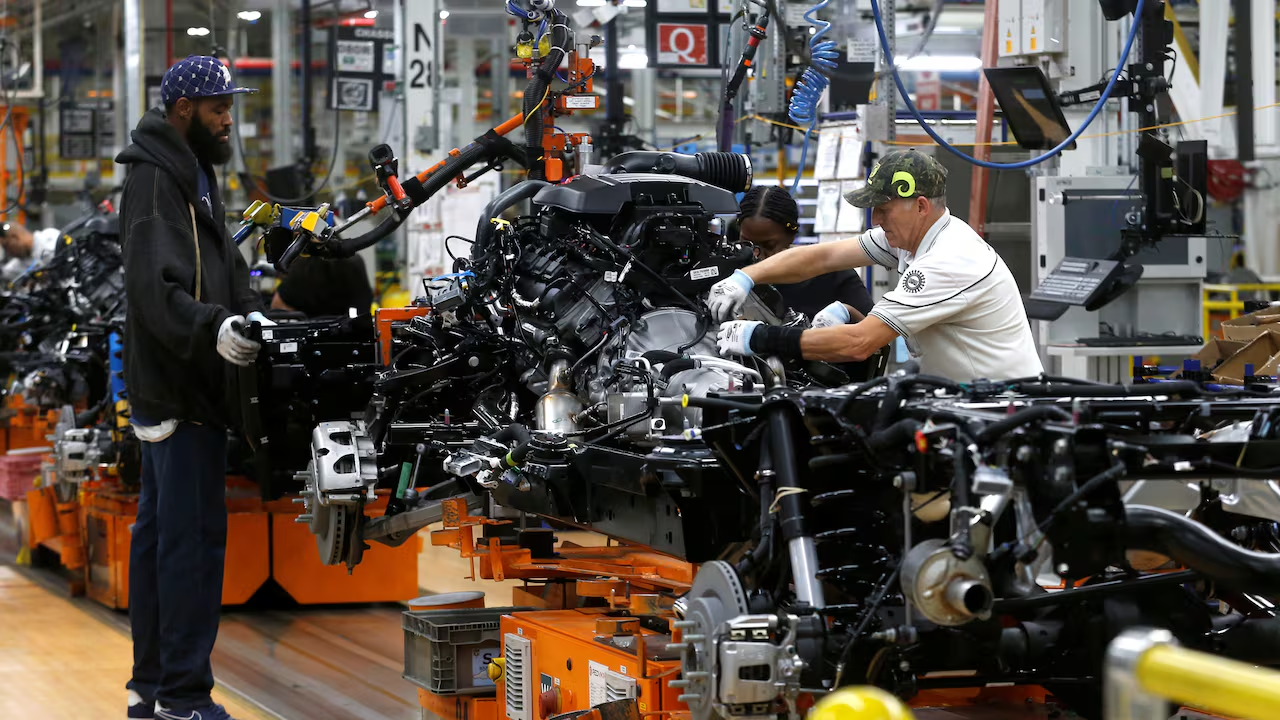
Over the past decade, the global automotive industry has undergone a seismic shift. Once dominated by a post-WWII logic of outsourcing and offshoring—where automakers flocked to low-cost labor markets in Mexico, China, and Eastern Europe—a new trend is now accelerating: automaker production relocation to US soil. Driven by supply chain disruptions, geopolitical tensions, new trade laws, and a massive push toward electrification, companies like Toyota, Honda, Volkswagen, and Tesla (which never really left) are either expanding U.S. facilities or moving entire production lines back from abroad.
The Drivers Behind the Relocation
Before analyzing the pros and cons, it is critical to understand why automaker production relocation to US markets is happening now. Three major catalysts stand out:
-
The Inflation Reduction Act (IRA) of 2022: This landmark legislation ties electric vehicle (EV) tax credits to domestic assembly and battery sourcing. To qualify for the $7,500 consumer credit, vehicles must be assembled in North America, with increasing percentages of battery components and critical minerals from the US or trade allies.
-
Supply Chain Fragility: The COVID-19 pandemic exposed the dangers of “just-in-time” global logistics. A semiconductor shortage in Taiwan or a port closure in Shanghai could halt US assembly lines. Proximity reduces risk.
-
Geopolitical Stability: Tariffs on Chinese imports (including EVs and components) and labor uncertainty in Mexico (due to potential USMCA renegotiations) make the US a more predictable, if more expensive, manufacturing base.
With these drivers in place, legacy automakers (Ford, GM, Stellantis) and foreign giants (Hyundai, BMW) have announced over $300 billion in new US manufacturing investments since 2021.
Benefits of Relocating Production to the US
1. Enhanced Supply Chain Resilience and Speed
The most immediate benefit of automaker production relocation to US facilities is a shorter, more controllable supply chain. When a factory in Michigan produces batteries for a plant in Ohio, the lead time drops from weeks (across an ocean) to hours. This allows automakers to respond to market demand in real time. During the 2021–2023 vehicle shortages, US-based manufacturers with localized supply fared significantly better than those reliant on Asian or European tier-2 suppliers. Shorter logistics also mean lower freight costs and reduced carbon footprint from shipping—an increasingly important ESG metric.
2. Access to Federal and State Incentives
Beyond the IRA’s EV tax credits, state-level incentives are aggressive. Georgia, Kentucky, Tennessee, and Michigan have become battlegrounds for megasites. For example, Hyundai’s 5.5billionEVplantinGeorgiareceivedover1.8 billion in state and local tax abatements, infrastructure improvements, and job training grants. Similarly, the CHIPS Act (while focused on semiconductors) indirectly benefits automakers by encouraging chip fabrication plants on US soil, solving a key bottleneck. These incentives can reduce the effective capital cost of a new US plant by 15–25%.
3. Skilled Workforce and Innovation Clusters
The US retains a highly skilled manufacturing workforce, particularly in the traditional “Rust Belt” and emerging “Battery Belt” (stretching from Michigan to Georgia). Unlike lower-cost regions, US workers are experienced in advanced robotics, automation, and complex assembly. Moreover, co-locating production with R&D centers (e.g., Toyota’s R&D in Michigan combined with assembly in Texas) accelerates innovation. Proximity allows engineers and line workers to collaborate daily, leading to faster problem-solving and continuous improvement.
4. Brand and Regulatory Advantages
“Made in the USA” carries significant brand equity, especially among domestic consumers. In a crowded EV market, buyers increasingly check window stickers for final assembly origin. Furthermore, operating entirely within US borders simplifies regulatory compliance. Automakers avoid customs duties (e.g., the 25% “Chicken Tax” on imported trucks), USMCA rules of origin paperwork, and potential future tariffs on Mexican or Canadian goods. Predictable legal and environmental standards reduce legal risk.
Challenges of Relocating Production to the US
If the benefits seem overwhelming, why hasn’t every automaker already shifted 100% of production to the US? The following challenges explain the slower-than-expected pace.
1. High Labor and Operational Costs
The single greatest barrier to automaker production relocation to US is cost. US autoworkers earn average hourly wages (including benefits) of 60–70,comparedto20–30 in Mexico and $10–15 in Vietnam or India. This is not just wages: US healthcare, worker’s compensation, and regulatory compliance (OSHA, EPA) add layers of expense. For labor-intensive components like wiring harnesses or interior trim, the unit cost in the US can be triple that of low-cost countries. Automakers must offset this through automation, but high-robot lines require enormous upfront capital.
2. Shortage of Specialized Labor
Paradoxically, while the US has skilled workers, it faces a severe shortage of electric vehicle-specific talent. Battery chemists, high-voltage technicians, and software engineers for autonomous systems are in fierce demand. Traditional auto mechanics often lack the retraining to handle EV powertrains. This has led to bidding wars for talent, driving up wages further. Moreover, the US education system has yet to produce enough vocational graduates trained in mechatronics and battery assembly. Many new plants have delayed openings because they could not hire enough qualified staff.
3. Infrastructure Gaps and Energy Costs
The US electrical grid is aging and fragmented. A new gigafactory (battery plant) consumes as much power as a small city. In Texas and California, grid instability during heatwaves or winter storms has forced manufacturing shutdowns. Additionally, industrial electricity rates in the US are higher than in China or the Middle East. Beyond power, logistics infrastructure is strained: US ports, rail networks, and highways were not designed for the explosive growth of EV battery shipping (heavy, hazardous materials). Building new dedicated rail spurs or upgrading substations can add $100–200 million to a plant’s cost.
4. Unionization and Labor Relations
The United Auto Workers (UAW) union has made clear that any new plant receiving public incentives must allow union organizing. Following the 2023 UAW strikes against the Big Three, new contracts raised top wages by 25% over four years. Non-union foreign automakers (Toyota, Honda, VW) face constant pressure from the UAW to organize their Southern US plants. While unions provide stability and skilled training, they also reduce management flexibility in shift scheduling, work rules, and layoffs during downturns. Some automakers quietly delay relocation to right-to-work states, but even those are becoming more union-friendly.
5. Supply Chain Depth (The Tier-N Problem)
While final assembly can move to the US, the deep supply chain often cannot. A single vehicle requires 10,000–15,000 parts. Many specialty components—certain semiconductors, rare earth magnets for motors, advanced LCD displays—are only made in Asia. Automaker production relocation to US is only as strong as its weakest link. For example, you can build a battery pack in Nevada, but the cobalt and lithium may still come from Congo or Australia, refined in China. Until the entire value chain is regionalized, the relocation is incomplete, leaving automakers exposed to foreign export restrictions.
Case Study: Tesla’s Success and Legacy Automakers’ Struggles
Tesla provides a proof of concept for successful US relocation. Over 70% of Tesla’s vehicle components (by value) come from North America, with its Fremont and Austin plants achieving some of the highest production yields globally. Tesla succeeded because it designed its factories around automation, avoided legacy union contracts, and vertically integrated battery production.
In contrast, Ford’s relaunch of the F-150 Lightning EV faced repeated delays and cost overruns at its Rouge plant, partly due to retooling older facilities and supply chain gaps for battery cells. General Motors’ Orion plant, slated for EV production, has seen launch pushed back multiple times due to software and battery module shortages. This contrast highlights that automaker production relocation to US is not a magic bullet—it requires a complete rethinking of manufacturing philosophy.
The Role of Automaker Production Relocation to US in National Security
It is impossible to discuss this topic without mentioning the national security angle. The Pentagon has classified advanced batteries and EV chips as critical to defense supply chains. A 2023 Department of Defense report warned that over-reliance on foreign production could cripple military logistics in a conflict. As a result, automakers relocating production to the US gain access to Defense Production Act funding and priority access to government fleet contracts. This adds a strategic benefit that transcends pure profit-and-loss calculations.
Future Outlook: Will the Trend Continue?
Between 2024 and 2026, over 15 new or expanded auto assembly and battery plants will open across the US, creating an estimated 100,000 direct jobs. However, the pace of automaker production relocation to US will depend on three variables:
-
Political stability of the IRA: A future administration could modify or repeal EV subsidies, crashing the business case for some plants.
-
Automation breakthroughs: If human labor becomes less central, the cost gap with Mexico closes, favoring US relocation.
-
Reshoring of materials refining: Unless the US builds its own lithium and graphite refining capacity, automakers will remain vulnerable.
Most industry analysts predict a “hybrid” future: Final assembly and battery pack production will heavily relocate to the US, while low-complexity, labor-intensive parts (fasteners, plastic trim, seat foam) will stay offshore. The US will become a high-value manufacturing hub, not a low-cost one.
Conclusion
The benefits of automaker production relocation to US are tangible: supply chain security, government subsidies, brand value, and innovation density. Yet the challenges—high costs, labor shortages, infrastructure fragility, and deep-tier dependencies—are equally real. This is not a story of simple repatriation but of strategic segmentation. Automakers are not returning all production; they are returning the most valuable, strategic, and subsidy-eligible production. For workers and communities, this offers real opportunity. For consumers, it may mean higher-priced vehicles made closer to home. The ultimate winner will be the US economy, provided policymakers continue to address the gaps in energy, training, and materials refining.
Frequently Asked Questions (FAQ)
1. What exactly does “automaker production relocation to US” mean?
It refers to the process of automakers moving vehicle assembly, component manufacturing, or battery production from foreign countries (e.g., Mexico, China, Germany, Japan) back to the United States. This can involve building new “greenfield” plants, expanding existing US factories, or shutting down foreign lines and transferring tooling.
2. Is this just about electric vehicles (EVs)?
Largely, but not exclusively. While the Inflation Reduction Act’s EV tax credits are the biggest driver, some internal combustion engine (ICE) production has also relocated due to supply chain disruptions. However, the vast majority of new investments—over 80%—are for EVs, batteries, and related components.
3. How many jobs has automaker production relocation to US created so far?
As of early 2025, announced projects since 2021 have committed to over 150,000 new direct auto manufacturing jobs. However, actual hires lag announcements. About 60,000 of those jobs are already filled, with the remainder expected by 2027.
4. Will this make cars cheaper for American buyers?
Not necessarily. While localized production avoids tariffs and shipping costs, higher US labor and regulatory expenses often offset those savings. Most analysts expect EV prices to remain flat or decline only slightly due to battery technology improvements, not relocation alone. However, automakers may absorb some costs to keep vehicles competitive.
5. Which states benefit the most from this relocation?
The biggest winners so far are Georgia (Hyundai, Rivian), Tennessee (Ford’s BlueOval City), Michigan (GM, Ford retooling), Kentucky (Ford battery plants), and Texas (Tesla, Toyota expansion). North Carolina and South Carolina are also attracting major battery supply chain investments.
6. What happens to Mexico and Canada under this trend?
Mexico will likely lose some final assembly but gain more low-cost component production (wiring, castings, trim). Canada is at greater risk, as many Canadian assembly plants (e.g., Stellantis in Windsor) face uncertain futures unless they secure EV battery investments. The USMCA trade agreement continues to protect some cross-border integration, but the center of gravity is shifting south of the Great Lakes.
7. Are foreign automakers (Toyota, Honda, and VW) moving production into the US or out of Japan/Germany?
Most are expanding US capacity rather than completely abandoning home country plants. For example, Toyota is building a new battery plant in North Carolina while continuing production in Japan. The relocation is additive, not zero-sum, for these global giants. However, some older European and Japanese lines are being phased out as US production ramps up.
8. What is the single biggest challenge automakers don’t talk about?
Talent. Industry executives privately state that finding enough qualified technicians to maintain high-robot assembly lines and battery chemistry labs is harder than managing costs. Community colleges and training programs are scaling up, but the lag time is 3–5 years.
9. Could a future president reverse the policies driving this relocation?
Yes, partially. The IRA’s EV tax credits could be repealed or modified by Congress. However, many state-level incentives are locked in via contracts. Additionally, automakers have already sunk billions into US factories; they won’t abandon them unless policies become extremely hostile. The momentum is likely self-sustaining through the late 2020s.
10. How can a small supplier prepare for automaker production relocation to US?
Small suppliers should: (1) Map their current exposure—are they feeding a Mexican plant or a US plant? (2) Explore near-shoring to the US border states (Texas, Arizona, and New Mexico) as a lower-cost alternative. (3) Seek federal grants under the Domestic Manufacturing Conversion Grant program. (4) Focus on automation to compete with lower-wage regions. Those that delay risk losing contracts to faster-moving competitors.