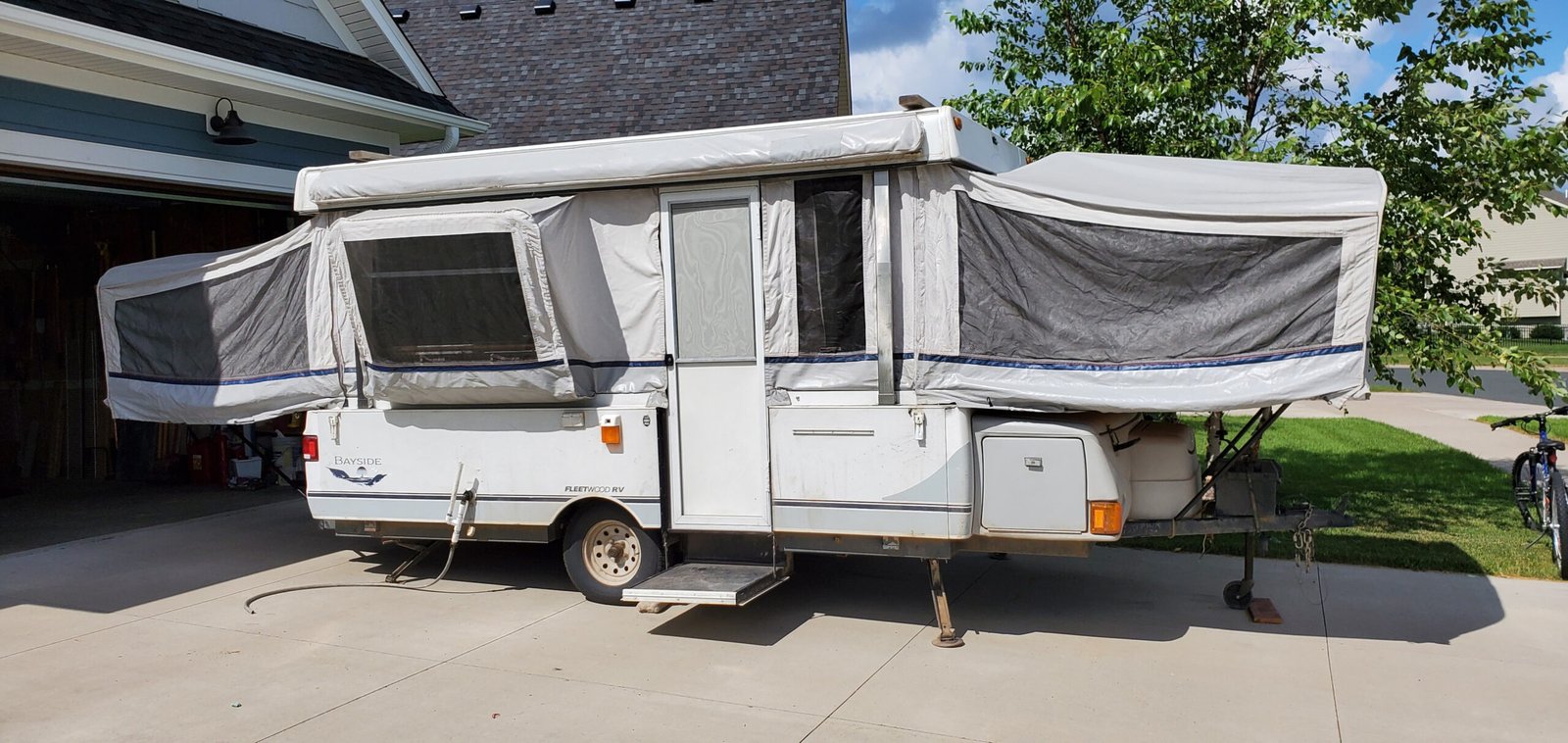
For enthusiasts of vintage camping, few names carry the weight and nostalgia of Fleetwood. Specifically, the early 2000s era represents a “goldilocks” zone for pop-up campers—modern enough to feature reliable electrical systems and ABS roofing, yet simple enough for the average weekend warrior to repair and tow with a minivan. Among these, the 2004 Fleetwood M280 CT stands out as a particularly spacious and well-appointed model.
While we often focus on mechanical specs or tow weights, the visual and spatial DNA of this camper is what truly defines the ownership experience. This article analyzes the design language, interior layout strategy, and stylistic choices of the 2004 M280 CT, helping you understand why these campers remain highly sought after on the used market.
The Visual Identity: 2000s “Fiberglass Fusion”
When searching for images of the 2004 M280 CT, the first thing you notice is the distinct front trunk and roofline. Fleetwood’s design philosophy in 2004 revolved around what they called “Aero-Flow” aerodynamics.
Exterior Styling Cues
Unlike the boxy, utilitarian look of the 1980s models, the 2004 M280 CT features rounded front corners and a swept-back roof cap. This wasn’t just for looks; it was designed to reduce drag behind larger SUVs and trucks. The color palette typically featured a base of Arctic White with bold, sweeping decals in shades of Teal, Silver, and Purple or sometimes Gold and Brown, depending on the production run.
The “CT” designation historically hinted at a “Country Trim” or similar touring package, which usually included:
-
Rust-resistant wheel wells: Painted in a textured black or dark gray to contrast the white body.
-
One-piece ABS roof: A major design feature that prevented the “soggy roof” syndrome of older canvas-topped units. This roof has a subtle texture to it, visible in close-up images.
-
Front Storage Trunk: Aerodynamically integrated into the tongue, featuring a lockable, overlapping lid to prevent rain intrusion.
Unpacking the Layout: The “Ultra Slide” Floorplan
The “M280” designation usually refers to a floorplan that prioritizes dinette space and king-sized beds. The 2004 model year was a transitional period where Fleetwood perfected the use of the “Truss System” for the lift mechanism.
The Center Kitchen Configuration
Images of the floorplan reveal a “center kitchen” layout. When you walk into this camper (with the canvas popped up), the kitchen is immediately to your left or right (depending on orientation), acting as a divider between the living space and the front bunk.
-
The Galley: Unlike smaller pop-ups, the M280 features a full three-burner stove (glass-covered), a deep stainless steel sink, and a 3-way refrigerator (propane/AC/DC). The design style here is “Late Utility”—formica countertops in a speckled grey or beige, designed to hide dirt and scratches.
-
The Dinette (Slide-out): The defining feature of the M280 CT is the street-side slide-out dinette. In transport mode, the dinette collapses inward. In images of the camper set up, you see the canvas “bump out” that extends roughly 18 to 24 inches. This transforms the camper from a narrow hallway into a spacious living room, easily seating four adults for cards or meals.
Sleeping Quarters
The M280 CT technically sleeps 6 to 8, but it does so with two distinct “wing” beds.
-
The Front Bunk (Queen/King): Accessed by crawling over the dinette or front storage area, this bed is massive. The 2004 design features “paned” windows in the canvas, allowing for cross-breezes.
-
The Rear Bunk (Double/Queen): Often featuring a privacy curtain, the rear bunk is slightly smaller than the front but benefits from being near the wardrobe.
Functional Style: Details You See in the Photos
When scrolling through photo galleries of vintage 2004 models, look for these specific design details that define the M280’s unique aesthetic.
The “Panorama” Windows
One of the most photographed features of the 2004 Fleetwood line is the extensive use of vinyl windows. Unlike competitors who used small, circular windows, Fleetwood used large, rectangular “picture windows” in the canvas. The M280 CT often features three large windows on the slide-out dinette alone, creating a greenhouse effect when the weather is nice.
Interior Fabric and Upholstery
The 2004 style leans heavily into “Southwest” or “National Park” themes.
-
Cushions: Typically a durable jacquard weave in forest green, burgundy, or dusty blue, featuring a subtle stripe or Southwestern geometric pattern.
-
Valances: Fleetwood included fabric valances over the metal crank channels. These are often the first thing to fade; original models feature a matching fabric to the cushions.
-
Flooring: Linoleum flooring that mimics slate or terra cotta tile, transitioning to carpet on the slide-out section.
The ABS Roof Texture
High-resolution images of the M280 CT often show a “dimpled” or “orange peel” texture on the roof. This is a design choice for strength in the ABS (Acrylonitrile Butadiene Styrene) material. Note for buyers: If you see bubbling or cracking in images of the roof, that is a red flag for delamination.
Structural Design: The “Off-Road” Lite Elements
While the M280 CT is not a dedicated “off-road” camper (like the newer “High Side” models), its 2004 design includes subtle ruggedness.
The Frame and Tires
The 2004 model rides on a boxed steel frame. From a side profile image, you will notice the clearance is higher than entry-level campers. The standard tire size was the 205/75R14—a common trailer tire that gives the camper a stout, planted look. The rims are typically white steel modular rims with a 5-lug pattern, covered by a simple chrome hubcap. This design prioritizes durability over flashy “mag” wheels.
Hitch Design
The “A-Frame” tongue features a curved design rather than sharp angles. This allowed for tighter turning radiuses. The design of the propane tank holder (usually a single or double tank mounted on the tongue) is integrated into the front fiberglass cap, making the front profile look unified.
Practicality vs. Aesthetics: The 2026 Perspective
As we look at these campers in 2026 (22 years after their production), the design holds up remarkably well compared to the “boxy” ultra-light trailers of the mid-2010s.
Removable Components
The 2004 design was “modular” before modular was cool. The dinette tables detach to form the bed base. The sink cover doubles as a cutting board. The design language focuses on “every inch counts.” Images of the storage compartments show cleverly angled cabinet doors that clear the canvas when the roof is lowered.
The Style of the Canvas
The canvas itself is a design feature. The 2004 M280 CT uses Weathermaster fabric or a similar poly-cotton blend. In sunlight, the fabric glows from the inside, providing natural ambient lighting. The design includes “drop-down” privacy awnings built into the bunk ends, a feature often missing in cheaper brands, which required external clamps.
Frequently Asked Questions (FAQ)
Here are the most common questions regarding the 2004 Fleetwood M280 CT, based on owner forums and technical guides.
1. What is the correct tire size for the 2004 Fleetwood M280 CT?
The original equipment tire size is 205/75R14. This is a Special Trailer (ST) radial tire. The recommended cold pressure is typically 50 PSI. When replacing tires, look for load ratings that support the camper’s GVWR of approximately 3,500 lbs.
2. Where can I find a replacement canvas for a 2004 M280 CT?
Since Fleetwood ceased production of pop-ups (and Coleman licensed the name elsewhere), original OEM canvas is rare. However, companies like Bear Creek Canvas and Canvas Replacements still produce aftermarket canvas for this model. You will need the model number (M280) and the year (2004) to ensure the zipper locations match the ABS roof profile.
3. Does the 2004 M280 CT have a toilet or shower?
Generally, the M280 CT was a “dry” model focused on sleeping and dining space. While some floorplans offered a “porta-potti” cubby, standard images of the CT edition typically show a wardrobe closet where a toilet might go in higher-end models. You will almost certainly not find a built-in shower in this specific variant.
4. How does the slide-out work on this model?
The dinette slide-out on the M280 CT is manual. Unlike heavy RV slides with hydraulics, Fleetwood used a “pull and push” system. You release the locking latches inside and push the wall out as you crank the roof up. When looking at images of the underside, you will see steel rails. Do not force the slide if the roof is down.
5. Why is the roof of my 2004 Fleetwood textured?
The roof is made of ABS plastic. The texture is not just cosmetic; it adds structural rigidity to the large, flat panel without adding significant weight. However, ABS is sensitive to UV rays. If you see images of cracked or “bubbled” roofs online, that is UV damage. Owners must regularly apply UV protectant (like 303 Aerospace) to preserve the roof’s integrity.
6. Is the 2004 M280 CT considered “high wall”?
No. A “high wall” pop-up typically has solid walls that extend partially up before the canvas starts. The M280 CT is a standard profile pop-up. When folded down, it sits relatively flat (approx. 4-5 feet tall). When popped up, the canvas extends fully from the roof to the box.
7. How much does a 2004 Fleetwood M280 CT weigh?
While exact weights vary by options (AC unit, etc.), the dry weight is approximately 2,200 to 2,500 lbs. The GVWR is around 3,500 lbs. This makes it towable by most V6 SUVs and minivans, provided they have a tow package.
8. What are the common “design flaws” I should look for?
Based on the design style of this era, look for corner rot (where the roof meets the canvas), crank lift system cable stretching, and delamination of the front fiberglass cap. Also, check the “ABS Roof” for fading; a chalky look in images means it needs immediate sealing.
9. Can I use a weight distribution hitch with this camper?
Due to the “A-frame” design and the folding tongue jack location, a traditional weight distribution hitch is often overkill and difficult to attach. Fleetwood recommended a simple friction sway bar for this model rather than a full distribution setup, due to the lightweight nature of the frame.
10. How does the 2004 M280 CT compare to a 2004 Coleman Utah?
Both were made by Fleetwood (Coleman brand license). The “Utah” was generally the entry-level or mid-level model, while the “M280 CT” often featured upgraded fabric interiors, the larger slide-out, and higher-spec appliance packages (like the 3-way fridge vs. a 2-way). The M280 usually has a longer box to accommodate the slide-out mechanism.