When the keyword Italian car production is mentioned, the mind immediately conjures images of curvaceous bodies, the roar of high-revving engines, and the scent of rich leather. Italy is not merely a country that builds cars; it is a philosophy of mobility where engineering meets arte. From the utter poverty of the post-war era to the cutting-edge electric hypercars of today, Italian car production has never been about mass transit in the mundane sense. It has been about passion.
However, behind the glamour of Ferrari and the chic of Fiat lies a complex industrial history—one of national pride, labor strikes, near-bankruptcy, and rebirth. This journey traces how a nation with no significant oil or steel reserves became the undisputed design capital of the automotive world.
The Birth of a Legacy (1899–1945)
The story of Italian car production began in Turin, the “Detroit of Italy.” In 1899, a group of investors, including Giovanni Agnelli, founded Fiat (Fabbrica Italiana Automobili Torino). Unlike the aristocratic carriage builders of France or the experimental engineers of Germany, Fiat focused immediately on versatility.
In 1908, the Fiat Tipo 1 became a household name, but it was the 1920s that saw the rise of Torpedo bodies. Yet, the pre-war era was dominated by a different beast entirely: Alfa Romeo. Founded in 1910 in Milan, Alfa Romeo immediately set the tone for Italian performance. The 1920s and 1930s saw the creation of the “8C” engine, a masterpiece of engineering that won the Mille Miglia and Targa Florio.
Meanwhile, in Modena, a young Enzo Ferrari was working as a driver for Alfa. He would later split off, and in 1947—just two years after the devastation of WWII—he founded Ferrari. The first car, the 125 S, didn’t have a V12 by accident; it was a declaration that Italian car production would prioritize emotion over economy.
The Economic Miracle: Cars for the Masses (1950s–1970s)
If Ferrari was the heart, Fiat was the skeleton. The true turning point in Italian car production arrived in 1957 with the Fiat 500, the Cinquecento. Designed by Dante Giacosa, this rear-engine, air-cooled vehicle put the entire nation on wheels. It was tiny, cheap, and ingeniously simple. By the mid-1960s, Italy had become a motorized society, and Fiat was the largest car manufacturer in Europe.
This era also introduced the world to the “Supercar.” In 1963, Automobili Lamborghini was founded. Ferruccio Lamborghini, a tractor magnate, was so insulted by a clutch failure in his Ferrari that he decided to build a better GT car. The result was the Miura (1966). The Miura didn’t just have a powerful engine; it placed that engine sideways in the middle of the chassis—the transversale layout. This invention by Giampaolo Dallara and Paolo Stanzani redefined automotive architecture forever. Every supercar since, from the McLaren F1 to the Bugatti Chiron, owes a debt to the mid-engine layout perfected in Italy.
The Dark Ages: Crisis and Consolidation (1980s–1990s)
By the late 1970s, Italian car production faced an existential crisis. Labor unions, terrorism (the Red Brigades), and the oil crisis hammered Fiat. Quality control was notoriously poor, and rust became synonymous with Italian steel.
Ironically, salvation came from the design houses. Pininfarina, Bertone, and Giugiaro’s Italdesign kept the flame alive. While Fiat built the practical Panda (1980) and Uno (1983) to survive, the passion projects moved to niche builders.
The 1980s gave us the Lancia Delta Integrale—a boxy hatchback that dominated World Rally Championship. The 1990s gave us the Alfa Romeo 156, a sedan so beautiful that when it won Car of the Year in 1998, it wasn’t just for the engine, but for the hidden rear door handles that preserved the coupe-like silhouette.
However, the financials were disastrous. By the early 2000s, Fiat was hemorrhaging billions. The Agnelli family had to call in a general: Sergio Marchionne. He merged Fiat with Chrysler in 2009, saving both companies from collapse. This era taught the industry that Italian car production could not survive on design alone; it needed corporate discipline.
The Modern Renaissance (2010–Present)
Today, Italian car production is a tale of two worlds: the hyper-luxury group and the electric transition.
Under the Stellantis umbrella (formed from the merger of Fiat Chrysler and PSA in 2021), Italy remains a hub for high-margin vehicles. The modern production lines in Modena and Maranello are masterpieces of lean manufacturing.
-
Ferrari (now a public company) produces icons like the SF90 Stradale, a hybrid V8 producing 986 horsepower. The process is so meticulous that Ferrari famously limits production to maintain exclusivity.
-
Lamborghini (under Audi/VW) produced the Revuelto, a V12 hybrid that screams into the electric future.
-
Maserati has retooled the historic Mirafiori plant in Turin to build the Grecale and the all-electric Folgore.
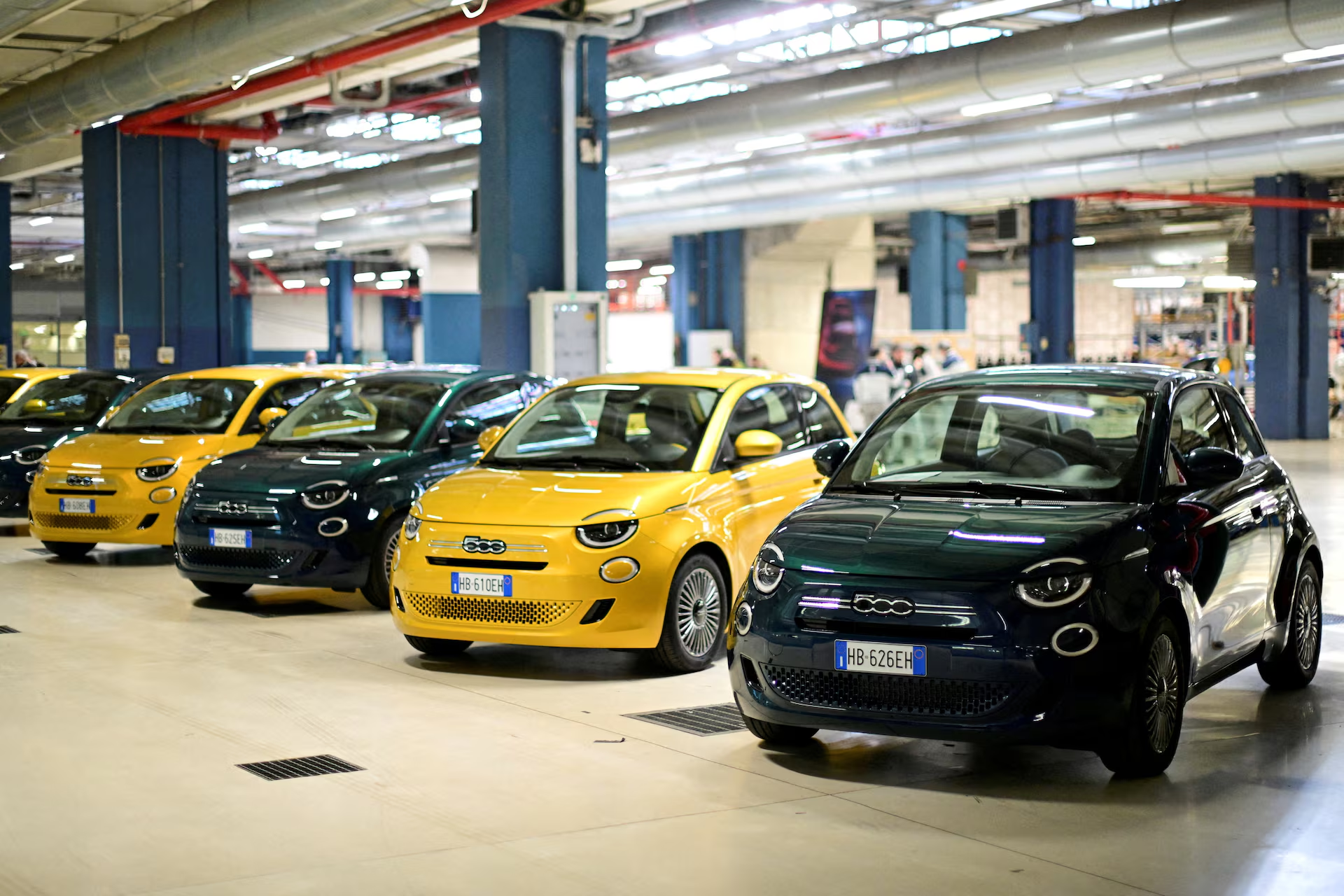
But the most significant change is the government’s push for Transizione 4.0. New factories for electric batteries are being built in Termoli and Bari. The Fiat 500e, produced in Turin, is the first mass-market EV to wear the Italian badge, proving that electric motors do not kill beauty.
The Design Houses: Where Form Meets Function
No discussion of Italian car production is complete without the Carrozzieri—the coachbuilders. Unlike Germany, where engineers run the show, in Italy, designers are gods.
-
Pininfarina (1930): Responsible for almost every classic Ferrari (Testarossa, Daytona) and the legendary Alfa Romeo Duetto. They moved from building bodies to engineering the entire vehicle, as seen in the Battista hypercar.
-
Italdesign (1968): Founded by Giorgetto Giugiaro. He gave the world the Volkswagen Golf Mk1, the DeLorean DMC-12, and the Lotus Esprit. His “folded paper” aesthetic defined the 1970s.
-
Zagato (1919): Known for double-bubble roofs and extreme, sometimes bizarre, aerodynamic experiments.
These houses act as a consultant layer to the world. Even today, when a Chinese EV manufacturer wants to look premium, they hire an Italian design house.
The Geography of Production
Understanding Italian car production requires a road trip:
-
Turin (Piedmont): The historical capital. Home to Fiat, Lingotto (the factory with the rooftop test track), and the National Automobile Museum.
-
Modena (Emilia-Romagna): The “Motor Valley.” Within a 30-mile radius, you find Ferrari (Maranello), Lamborghini (Sant’Agata Bolognese), Pagani (San Cesario sul Panaro), and Maserati (Modena centre).
-
Bologna: Home to Ducati (though motorbikes, they share the performance DNA) and Lamborghini’s design center.
-
Pomigliano d’Arco (Naples): The gritty southern plant where the Fiat Panda—the car that keeps the Italian working class employed—is assembled.
Challenges Facing Italian Car Production Today
Despite the glamour, the industry is fragile. In 2024, Italian car production hit a 67-year low, falling below 800,000 units per year. For context, Germany produces ~4 million. Why?
-
The Shift to EVs: Italy lacks a massive battery gigafactory (though ACC is building one in Termoli). Politicians argue that high electricity costs make Italy uncompetitive for producing affordable EVs.
-
Domestic Market Collapse: Italians are getting older and poorer. Young Italians no longer see cars as a status symbol; they prefer urban public transit. Many buy used German cars instead of new Fiats.
-
The Stellantis Paradox: While Stellantis owns the Italian brands, it produces many “Italian” cars in Poland (Fiat 600) or Serbia (Panda). This has led to political tensions; the current Italian government accuses Stellantis of betraying the nation.
-
Luxury Over Volume: Ferrari and Lamborghini are profitable, but they make only ~20,000 units annually combined. Mass production (Fiat, Lancia, Alfa Romeo) is the problematic segment.
Performance Engineering: The Italian Soul
Why does a Ferrari feel different from a Porsche? It is the gran turismo ethos.
German cars are precise; Italian cars are emotional. This is achieved through specific engineering choices:
-
Steering: Italian cars prefer lively, quick-ratio steering that encourages oversteer (the rear sliding out). German cars demand understeer (safety).
-
Sound: Italian laws on noise are laxer than Euro norms, historically. The wail of a naturally aspirated V12 or the bark of a Busso V6 is intentionally tuned for auditory pleasure.
-
Materials: While German cars use “logical” plastics, Italians will wrap a dashboard in leather that takes a worker three days to stitch, even if it leaks when it rains.
The Future: Small, Electric, and Agile
The next decade will define whether Italian car production survives. The 2025 Alfa Romeo Milano (now renamed Junior due to political naming disputes) is a compact EV crossover. The Lancia Ypsilon has returned as an electric hatchback with a “cassette” center console.
Furthermore, startups like Aehra (from Milan) are designing futuristic electric sedans, while Pininfarina builds the Battista—the most powerful road-legal Italian car ever made (1,900 hp).
The secret weapon remains design. In a world where EVs from Tesla or BYD look like smooth jellybeans, Italy offers sculpture. The new Maserati GranTurismo Folgore proves that an electric car can have sex appeal.
Conclusion
Italian car production is not a story of efficiency. It is a story of resilience. It has survived wars, oil crises, corporate raids, and a constant shortage of money. It has produced some of the most unreliable, rust-prone vehicles ever made—but also the most beautiful.
When you see a 1960s Alfa Romeo Giulietta, you don’t see the electrical gremlins; you see a love letter to the road. As the world goes electric, silent, and autonomous, Italy’s challenge is to ensure that the feeling of driving—the vibration, the steering weight, the emotional connection—is not lost.
La passione italiana is the only engine that never breaks down.
Frequently Asked Questions (FAQ)
Q1: What is the current state of Italian car production in 2025-2026?
A: As of 2026, Italian car production is in a transitional crisis. Volume is low (under 800,000 units annually), largely due to the shift to EVs and high energy costs. However, the luxury segment (Ferrari, Lamborghini, Maserati) is booming. Stellantis is under pressure from the Italian government to increase output at the Mirafiori and Pomigliano plants, focusing on the Fiat 500e and new Alfa Romeo models.
Q2: Why are Italian cars often considered unreliable compared to Japanese or German cars?
A: Historically, Italian car production prioritized emotion over electronic reliability. Pre-1990s models suffered from poor rust-proofing, finicky electrical systems (especially under the Fiat era), and complex maintenance schedules. However, modern Italian cars (post-2015) have closed the gap significantly. Today, a Ferrari or Alfa Romeo Giulia shares many electronic modules with German brands (Bosch/Continental), making them as reliable as a BMW, though they are still more expensive to maintain.
Q3: Which Italian car brands are still 100% Italian-owned?
A: Almost none. Ferrari is publicly traded on the NYSE and Euronext, with major shareholders including Exor (the Agnelli family). Lamborghini is owned by Germany’s Audi (Volkswagen Group). Maserati and Alfa Romeo are owned by Stellantis (a Dutch-registered multinational). The only truly independent Italian sports car manufacturer is Pagani Automobili (based in Modena). Dallara (automotive engineering) is also independent.
Q4: Where are most Italian cars actually built?
A: While the design is always Italian, assembly varies:
-
Ferrari: Maranello, Italy.
-
Lamborghini: Sant’Agata Bolognese, Italy.
-
Fiat 500e: Turin, Italy.
-
Fiat Panda (gas version): Pomigliano d’Arco, Italy.
-
Fiat 600 (hybrid): Tychy, Poland (badged as Italian, built abroad).
-
Maserati Grecale: Cassino, Italy.
-
Alfa Romeo Tonale: Pomigliano, Italy.
Q5: Is there an Italian electric supercar?
A: Yes. The Pininfarina Battista (built in Cambiano, Italy) is an all-electric hypercar with 1,900 horsepower. Also, the Lamborghini Revuelto is a V12 plug-in hybrid. The Maserati GranTurismo Folgore is a fully electric grand tourer. Fiat also produces the 500e, an electric city car.
Q6: Why doesn’t Italy produce a mass-market cheap electric car like the Chinese or French?
A: High manufacturing costs. Electricity prices in Italy are roughly 30% higher than in France. Labor costs in Turin are similar to Munich. Additionally, Italy lacks a domestic battery cell factory (though one is under construction in Termoli). Consequently, Stellantis prefers to build cheap EVs (like the Citroën e-C3) in Eastern Europe to keep prices under €25,000.
Q7: What is the “Motor Valley” in Italy?
A: The Motor Valley is the region of Emilia-Romagna (Modena, Bologna, Parma). It is the highest concentration of high-performance automotive manufacturers in the world, including Ferrari, Lamborghini, Pagani, Maserati, Dallara, and Ducati. The region also hosts museums, racetracks (Imola, Modena), and the annual Motor Valley Fest.
Q8: Is the Fiat brand ending?
A: No, but it is shrinking. Under Stellantis CEO Carlos Tavares, Fiat has been reduced to focusing exclusively on the 500e (city car) and the Panda (cheap utility). The Fiat Tipo and Fiat 124 Spider have been discontinued. Fiat survives as a “niche global brand” but no longer competes in the C-segment (Golf/Corolla class) like it did in the 1990s.
Q9: Can I visit Italian car factories?
A: Yes, but reservations are mandatory.
-
Ferrari (Maranello): Offers the “Museo Ferrari” and factory tours via the “Ferrari Museum Pass.”
-
Lamborghini (Sant’Agata): Offers factory and museum tours (book weeks in advance).
-
Pagani (Modena): Offers the “Pagani Atelier” tour (very limited slots, expensive).
-
Fiat (Turin): The historic Lingotto factory is now a shopping mall/hotel with a rooftop test track you can walk on, but the active assembly line is not usually open to the public.
Q10: How does Italian car production compare to German car production?
A:
-
Volume: Germany produces ~4M cars/year; Italy ~800k.
-
Focus: Germany dominates premium volume (Mercedes, BMW, Audi) and luxury. Italy dominates hypercars and design.
-
Philosophy: German engineering is “objective” (lap times, efficiency). Italian engineering is “subjective” (steering feel, noise, beauty).
-
EV Transition: Germany is moving faster (VW ID family, Mercedes EQ). Italy is relying on its luxury brands to lead the EV charge slowly.