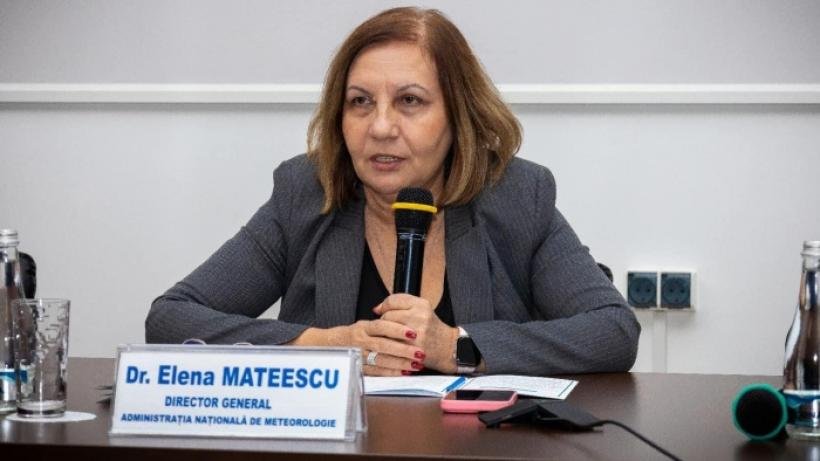
In the world of science and public service, few figures manage to bridge the gap between complex meteorological data and the daily life of the general public. In Romania, Elena Mateescu has become a household name, not just because she appears on news broadcasts explaining weather phenomena but because she has fundamentally transformed the country’s approach to climate science.
As the first female director general in the 140-year history of the National Meteorological Administration (ANM), Mateescu represents a story of perseverance, academic excellence, and visionary leadership. She has steered Romania into the elite of international meteorology, advocating for climate adaptation and agricultural resilience. This article explores the life, age, and remarkable professional journey of one of Europe’s leading meteorologists.
Early Life and Age: The Roots of a Leader
Understanding the biography of Elena Mateescu requires looking beyond her titles to her origins. Born on December 19, 1963, in Caracal, Romania, she grew up in an environment that valued practical knowledge and resilience. As of 2026, she is 62 years old.
Her early years were marked by a connection to the land. She pursued her higher education at the University of Agronomic Sciences and Veterinary Medicine in Bucharest. In 1990, she graduated as a licensed agricultural engineer, a specialized degree that combined hard science with the practical realities of farming and land management.
This background is crucial to understanding her career. While many meteorologists come from physics or mathematics, Mateescu came from agriculture. This unique perspective allowed her to see weather not just as atmospheric pressure systems but as the primary variable affecting food security and economic stability.
The Accidental Career: How a “Tip” Changed Everything
Regarding the specific keyword times Elena Mateescu, her entry into meteorology was somewhat serendipitous. She often recounts that she did not initially plan to work in weather forecasting. Following the Romanian Revolution of 1989, she was a young graduate looking for direction.
The turning point came through a conversation with a colleague. It was this friend who gave her a “tip” (a “pont”) about a job opening at the Agrometeorology Laboratory within the National Institute of Hydrology and Water Management. Her friend, preferring to go into production agriculture, suggested that Mateescu was better suited for the scientific rigor of the lab. She took the chance, and on November 16, 1990, she walked through the doors of the institution where she would spend the next 35 years (and counting) of her life.
Education and Academic Foundation
While she started working in 1990, Elena Mateescu never stopped learning. She continued her academic pursuits, earning a Ph.D. in Agronomy in 2001 from the University of Agronomical and Veterinary Sciences in Bucharest. Her doctoral thesis focused on the “Research of the climatic resources fluctuation on the vegetation and the winter wheat and maize production in the southern area of the Romanian Plain.”
This research solidified her reputation as a specialist in agrometeorology—the study of weather and climate’s impact on agricultural systems. She didn’t remain purely in the operational side of weather; she entered academia as well. In 2013, she became an associate professor at her alma mater, teaching courses on climate change at the Faculty of Land Reclamation and Environmental Engineering.
The Professional Journey: Climbing the Ladder
Elena Mateescu’s professional journey is a masterclass in institutional memory and gradual, earned ascension.
For the first 26 years of her career, she worked as a researcher and expert within the agrometeorology department. She wasn’t just watching the weather; she was developing models to predict drought, advising farmers on planting strategies, and contributing to global scientific literature.
In 2011, she briefly stepped into an executive role, serving as the executive director of the ANM. However, the historic moment came on December 19, 2016. On her 53rd birthday, she was appointed director general of the National Meteorological Administration. This was a landmark event: she became the first woman to lead the institution since its founding in 1884.
Her leadership style is widely praised for combining scientific rigor with approachable communication. Under her tenure, the ANM has seen massive modernization. She has overseen the transition from manual observations to a network of 166 automated weather stations, with plans to add 400 more via the PNRR (National Recovery and Resilience Plan), representing cumulative investments of approximately 150 million euros.
Global Recognition and The Silver Medal
While she is a public figure in Romania, Elena Mateescu is a scientific heavyweight on the global stage. Her contributions have not gone unnoticed. In 2022, she was awarded the EMS Silver Medal by the European Meteorological Society.
The EMS recognition was for her “lifelong scientific contribution to the field of agrometeorology and outstanding services to the European meteorological community.” This award specifically highlighted her work on assessing the impact of climate change on agricultural production and her role as a chapter lead author for the Fifth Assessment Report of the Intergovernmental Panel on Climate Change (IPCC)—the same reports that form the basis of global climate policy.
Furthermore, in a testament to her diplomatic and scientific leadership, she was elected president of the Regional Association VI (Europe) of the World Meteorological Organization (WMO) in May 2023. This position places her on the Executive Council of the WMO, marking the first time Romania has held such a high-ranking role in the organization’s hierarchy.
The Legacy: The European Agrometeorology Centre
Perhaps the most concrete achievement of Elena Mateescu’s tenure is the establishment of the first European Agrometeorology Centre in Romania. This is a global pilot project, requested by the WMO and funded by European funds exceeding two million euros.
This center is designed to be a hub for data exchange regarding soil water reserves, phenology, and climate scenarios affecting agriculture. It represents her vision: that Romania should not just be a consumer of climate data but a producer and distributor of knowledge to help the entire continent adapt to global warming.
Personal Life and Recognitions
Beyond the official biography, Mateescu is known for her advocacy for gender equality in STEM fields. She was elected a corresponding member of the Academy of Agricultural and Forestry Sciences “Gheorghe Ionescu-Șișești” in 2015. She maintains a connection to the academic world, ensuring that the next generation of meteorologists is trained.
Her personal story is one of quiet dedication; she rarely discusses her private family life in public, preferring to focus on the mission of the ANM. However, those who know her describe a leader with a “vibrating” passion for her work—a person who sees weather not as a backdrop but as “the scene where technology, science, and passion meet.”
Frequently Asked Questions (FAQ)
Q1: Who is Elena Mateescu?
A: Elena Mateescu is a Romanian agrometeorologist and the Director General of the National Meteorological Administration (ANM). She is the first woman to hold this position in the institution’s history. She is a respected figure in the World Meteorological Organization (WMO), currently serving as President of Regional Association VI (Europe).
Q2: How old is Elena Mateescu?
A: Elena Mateescu was born on December 19, 1963. As of 2026, she is 62 years old.
Q3: What is Elena Mateescu’s educational background?
A: She holds a B.Sc. in Agricultural Engineering (1990) and a Ph.D. in Agronomy (2001) from the University of Agronomic Sciences and Veterinary Medicine in Bucharest. She is also an associate professor at the same university.
Q4: What is Elena Mateescu known for internationally?
A: She is known for her leadership in agrometeorology. She was a Lead Author for the IPCC’s Fifth Assessment Report, won the EMS Silver Medal in 2022, and leads the WMO’s European region. She is also the driving force behind the first European Agrometeorology Centre in Bucharest.
Q5: How long has Elena Mateescu worked at the meteorological administration?
A: She began her career at the institution on November 16, 1990. As of 2026, she has been active in the field for over 35 years.
Q6: What is her specific field of expertise?
A: Her expertise is Agrometeorology. This involves studying the interaction between meteorological and hydrological conditions and agriculture, specifically focusing on drought monitoring, the impact of climate change on crop yields (such as wheat and maize), and adaptation strategies.