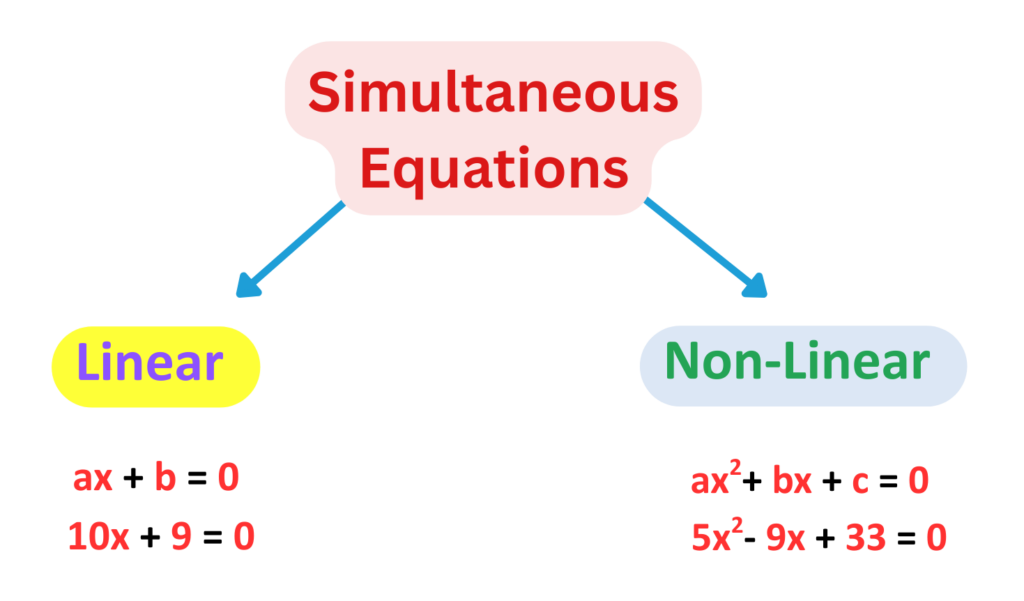
Simultaneous equations might sound intimidating, but they are simply a set of equations that share the same variables (like x and y). Solving them allows you to find the one specific point where two mathematical conditions are true at the same time. Whether you are calculating a budget, comparing social media stats, or predicting profit, these skills are vital.
Below are 10 clear examples of linear simultaneous equations, ranging from basic substitution to real-world word problems. Each example follows a “Step-by-Step Solution” format to guide you through the logic.
Part 1: The Fundamentals – Elimination Method
The elimination method focuses on adding or subtracting equations to cancel out (eliminate) one variable.
Example 1: Adding to Eliminate
Solve the system:
x+y=10x−y=4x+yx−y=10=4
Step-by-Step Solution:
-
Check the coefficients: Notice the
+yin the first equation and the-yin the second. If we add these, theyvariables will cancel out instantly because y+(−y)=0y+(−y)=0. -
Add the equations:
(x+x)+(y−y)=10+4(x+x)+(y−y)=10+42x=142x=14
-
Solve for x:
x=142=7x=214=7
-
Substitute back: Plug x=7x=7 into the first equation.
7+y=107+y=10y=3y=3
-
Solution: x=7,y=3x=7,y=3.
Example 2: Subtracting to Eliminate
Solve the system:
3x+2y=162x+2y=123x+2y2x+2y=16=12
Step-by-Step Solution:
-
Observe: Both equations have +2y+2y. If we subtract one equation from the other, the
yterms cancel. -
Subtract Equation 2 from Equation 1:
(3x−2x)+(2y−2y)=16−12(3x−2x)+(2y−2y)=16−12x=4x=4
-
Substitute x=4x=4 into 2x+2y=122x+2y=12:
2(4)+2y=122(4)+2y=128+2y=12 ⟹ 2y=4 ⟹ y=28+2y=12⟹2y=4⟹y=2
-
Solution: x=4,y=2x=4,y=2.
Example 3: Multiplying One Equation (The Times Table Strategy)
Sometimes the variables don’t line up perfectly. You must multiply one equation by a number to make them match.
Solve the system:
2x+5y=96x−4y=82x+5y6x−4y=9=8
Step-by-Step Solution:
-
The Plan: Look at the
xterms (2xand6x). If we multiply the entire first equation by 3, we get6x, which will match the second equation. -
Multiply the whole equation: 3×(2x+5y=9)3×(2x+5y=9) becomes 6x+15y=276x+15y=27.
-
Subtract the equations: Now we have:
6x+15y=276x−4y=86x+15y6x−4y=27=8
Subtract to eliminate
6x: (15y−(−4y))=27−8(15y−(−4y))=27−8 => 19y=1919y=19 => y=1y=1. -
Solve for x: Substitute y=1y=1 into 2x+5(1)=92x+5(1)=9 => 2x=42x=4 => x=2x=2.
-
Solution: x=2,y=1x=2,y=1.
Example 4: Multiplying Both Equations
Solve the system:
3x+5y=144x+3y=153x+5y4x+3y=14=15
Step-by-Step Solution:
-
Match Coefficients: We need to make the
xterms match. The lowest common multiple of 3 and 4 is 12.-
Multiply Equation 1 by 4: 12x+20y=5612x+20y=56
-
Multiply Equation 2 by 3: 12x+9y=4512x+9y=45.
-
-
Subtract:
(12x−12x)+(20y−9y)=56−45(12x−12x)+(20y−9y)=56−4511y=11 ⟹ y=111y=11⟹y=1
-
Substitute: y=1y=1 into 3x+5(1)=143x+5(1)=14 => 3x=93x=9 => x=3x=3.
-
Solution: x=3,y=1x=3,y=1.
Part 2: Real-World & Social Media Scenarios
Simultaneous equations are everywhere in digital marketing and social media analytics. Let’s look at two examples involving social media links and follower counts.
Example 5: The Social Media Follower Count
Problem: Abby uses two social media sites. On Site A, she has 52 more followers than Site B. Combined, she has 700 followers total. How many followers does she have on each site? Note: This scenario uses data similar to common Instagram and X (Twitter) analytics queries.
Step-by-Step Solution:
-
Define Variables:
Let AA = followers on Site A.
Let BB = followers on Site B. -
Form Equations:
-
Info 1: A=B+52A=B+52 (52 more on A)
-
Info 2: A+B=700A+B=700 (Total followers)
-
-
Substitution Method: Since we know A=B+52A=B+52, plug it into the total equation.
(B+52)+B=700(B+52)+B=7002B+52=7002B+52=7002B=648 ⟹ B=3242B=648⟹B=324
-
Find A: A=324+52=376A=324+52=376.
-
Conclusion: Site A has 376 followers; Site B has 324 followers.
Example 6: Comparing Engagement Rates
Problem: On LinkedIn, a professional posted two updates. Update 1 received 6 likes and 19 shares, generating 240 click-throughs. Update 2 received 11 likes and 14 shares, generating 190 click-throughs. Assuming every like and share generates a specific number of clicks, how many clicks does one “like” generate?
(Derived from coefficient strategies)
Step-by-Step Solution:
-
Define Variables:
Let xx = clicks generated by 1 Like.
Let yy = clicks generated by 1 Share. -
Form Equations:
6x+19y=2406x+19y=24011x+14y=19011x+14y=190
-
Elimination Strategy: We need to eliminate yy. Multiply the first by 14 and the second by 19:
-
Eq 1 (×14×14): 84x+266y=336084x+266y=3360
-
Eq 2 (×19×19): 209x+266y=3610209x+266y=3610
-
-
Subtract: (209x−84x)+(266y−266y)=3610−3360(209x−84x)+(266y−266y)=3610−3360
125x=250 ⟹ x=2125x=250⟹x=2
-
Conclusion: One “like” generates 2 clicks.
Part 3: The Substitution Method
Sometimes, solving for one variable and plugging it into the other equation is faster.
Example 7: Easy Substitution
Solve the system:
y=2x+13x+2y=9y3x+2y=2x+1=9
Step-by-Step Solution:
-
Notice: Equation 1 already tells us what
yequals. -
Substitute: Replace
yin Equation 2 with 2x+12x+1.3x+2(2x+1)=93x+2(2x+1)=93x+4x+2=93x+4x+2=97x=7 ⟹ x=17x=7⟹x=1
-
Find y: y=2(1)+1=3y=2(1)+1=3.
-
Solution: x=1,y=3x=1,y=3.
Example 8: Rearrange and Substitute
Solve the system:
2x+y=7x−y=22x+yx−y=7=2
Step-by-Step Solution:
-
Isolate: Using the second equation (x−y=2x−y=2), solve for xx: x=y+2x=y+2.
-
Substitute into 2x+y=72x+y=7:
2(y+2)+y=72(y+2)+y=72y+4+y=72y+4+y=73y=3 ⟹ y=13y=3⟹y=1
-
Find x: x=1+2=3x=1+2=3.
-
Solution: x=3,y=1x=3,y=1.
Part 4: Word Problems & Practical Scenarios
Example 9: The Cinema Ticket Problem
Problem: At a cinema, a family bought 2 drinks and 4 popcorn bags for £15. Another family bought 3 drinks and 2 popcorn bags for £10.50. Find the cost of one drink.
Step-by-Step Solution:
-
Variables:
Let dd = cost of a drink.
Let pp = cost of popcorn. -
Equations:
2d+4p=15.002d+4p=15.003d+2p=10.503d+2p=10.50
-
Eliminate pp: Multiply the second equation by 2 to match the pp coefficients.
-
×2×2: 6d+4p=21.006d+4p=21.00
-
-
Subtract the first equation from this new equation:
(6d−2d)+(4p−4p)=21.00−15.00(6d−2d)+(4p−4p)=21.00−15.004d=6.00 ⟹ d=1.504d=6.00⟹d=1.50
-
Substitute: 2(1.50)+4p=152(1.50)+4p=15 => 3+4p=153+4p=15 => 4p=124p=12 => p=3p=3.
-
Answer: A drink costs £1.50, and popcorn costs £3.00.
Example 10: The Rectangle Perimeter
Problem: The perimeter of a rectangle is 50 units. The area is 100 square units. Find the side lengths.
Step-by-Step Solution:
-
Variables:
Let ll = length, ww = width. -
Formulas:
-
Perimeter: 2l+2w=502l+2w=50 (Simplify: l+w=25l+w=25)
-
Area: l×w=100l×w=100
-
-
Substitution: From the perimeter, w=25−lw=25−l. Plug into the area:
l×(25−l)=100l×(25−l)=10025l−l2=10025l−l2=1000=l2−25l+1000=l2−25l+100(l−5)(l−20)=0(l−5)(l−20)=0
-
Solutions: l=5l=5 or l=20l=20.
-
If l=5l=5, w=20w=20.
-
If l=20l=20, w=5w=5.
-
-
Answer: The sides are 20 units and 5 units.
Part 5: FAQ – Simultaneous Equations
Here are the top five questions students ask when studying this topic.
Q1: What exactly are simultaneous equations?
Simultaneous equations are two or more equations that share variables. You need to find a value for x That works for all equations at the same time. ime If you only solve one equation, there are infinite solutions; the second equation narrows it down to just one (or a few).
Q2: How do I know which method to use (Elimination vs. Substitution)?
-
Use Elimination when both equations are in the standard form Ax+By=C,Ax+By=C and the coefficients are easy to multiply to match.
-
Use Substitution when one variable is already isolated (e.g., y=3x+2y=3x+2) or can be isolated very easily (e.g., x+y=10x+y=10).
Q3: I multiplied the equations, but my answer doesn’t work. Why?
This is usually a sign of an error! Remember: If you are adding to eliminate, be careful with negatives. If you are subtracting, make sure you subtract every term.
-
Pro Tip: If you get a strange decimal, plug it back into the original equations to check your work
Q4: Can I solve simultaneous equations on a graph?
Yes. The solution to a pair of linear equations is the point where the two lines cross (x,yx,y). However, graphical methods can be inaccurate if the answer is a fraction or decimal, which is why algebra (the methods above) is preferred for accuracy.
Q5: How do I handle equations with three variables (x, y, z)?
The logic is the same, but it takes longer. You use the equations times two to eliminate one variable, leaving you with two equations and two unknowns. You then solve those two using the methods above.
Part 6: Why This Matters & Social Learning
Solving these equations is a fundamental algebraic skill used in business analytics, engineering, and computer science. To see how others approach these problems or to share your own solutions, connect with study communities on Instagram (look for the hashtag #MathHelp) or join discussion groups on LinkedIn. By mastering these 10 examples, you have built the foundation to solve complex systems of equations with confidence. Keep practicing the times tables for coefficients, and the logic will become second nature.