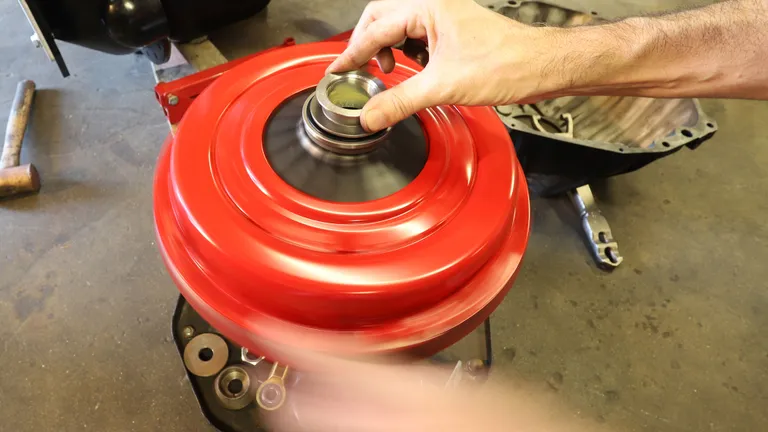
For enthusiasts of the manual transmission, the act of shifting gears is a dance of mechanical poetry. Your left foot depresses the clutch pedal, your right hand selects a new gear, and the car responds with seamless acceleration. However, hidden within the bell housing—the metal casing between the engine and transmission—lies a small but mighty component that makes this entire process possible: the throw out bearing (also known as the clutch release bearing).
Despite its critical role, the throw out bearing is often the most neglected and misunderstood part of a manual drivetrain. It operates in a hostile environment of extreme heat, high-speed rotation, and clutch dust. When it fails, it often takes the clutch and flywheel with it, leading to a repair bill that can exceed $1,500. To understand why this bearing is so vital, you must first understand the violent friction war happening every time you drive.
The Anatomy of Engagement: What Is a Throw Out Bearing?
Before explaining how it works, you need to know what it is. The throw out bearing is a specialized, sealed ball bearing assembly mounted on a sliding sleeve (called the quill or bearing carrier). It sits stationary on the transmission’s input shaft cover, hovering just millimeters away from the rotating pressure plate fingers.
Visually, it looks like a donut made of steel and grease. The inner race attaches to the stationary sleeve, while the outer race is designed to spin freely. One side of the bearing is flat (for the clutch fork), and the other side has a polished, curved face designed to press against the diaphragm spring fingers of the pressure plate.
The keyword used in this context is crucial: A throw out bearing is used to convert linear motion (your foot pushing the pedal) into rotational motion and axial force (pushing the pressure plate). Without it, the clutch fork would grind directly against the spinning pressure plate, creating sparks, metal shavings, and catastrophic failure within one second.
The Physics of Disengagement: How It Actually Works
To understand the throw out bearing, you must understand the clutch’s two states: engaged (foot off the pedal) and disengaged (foot on the pedal).
State 1: Resting (Foot Off the Pedal)
When your foot is off the clutch pedal, the engine flywheel is spinning. The clutch disc is squeezed tightly between the flywheel and the pressure plate. The pressure plate’s diaphragm spring is pushing outward with immense force (hundreds of kilograms). The throw out bearing is stationary, resting against the clutch fork but not touching the pressure plate. There is a small air gap (typically 0.5mm to 1.5mm) between the bearing face and the diaphragm spring fingers. In this state, the bearing is idle. It doesn’t spin, doesn’t wear, and simply waits.
State 2: Disengaging (Foot Pushes the Pedal)
Here is where the throw out bearing becomes the hero. When you depress the clutch pedal, hydraulic fluid (or a cable) pushes the clutch fork. The fork acts like a seesaw, pivoting on a ball stud. As one end of the fork moves forward, the other end (holding the throw out bearing) moves backward—toward the engine.
The bearing contacts the rotating diaphragm spring fingers. Immediately, friction would normally weld the two parts together. However, the ball bearing inside the throw out bearing spins. The outer race touches the spinning pressure plate and rotates along with it, while the inner race remains stationary against the fork. This bearing action allows the fork to push with tons of force while the engine continues to spin at 2,000+ RPM.
As the bearing pushes the diaphragm spring fingers inward, the spring pivots on its fulcrum rings. The outer edge of the pressure plate lifts away from the clutch disc. The disc is now free to stop spinning (or spin independently of the engine). You can now shift gears without grinding synchros.
The “Used” Keyword in Context: Wear and Duty Cycles
The keyword used implies consumption, and the throw out bearing is a textbook consumable part. Every time you depress the clutch pedal, you use a small amount of the bearing’s finite lifespan. Engineers design these bearings for a specific number of duty cycles (typically 150,000 to 200,000 pedal depressions).
Why does it wear? Despite being a sealed bearing, three factors degrade it:
-
Heat: The pressure plate fingers can reach 300°F (150°C). That heat radiates into the bearing grease. Over time, the grease liquefies and leaks out.
-
Axial Load: Bearings are happy with radial loads (like a wheel spinning). A throw out bearing experiences axial (thrust) loads—pushing directly along its axis. This forces the balls against the edges of their races, creating high contact stress.
-
Contamination: Clutch dust (carbon fiber and resin from the clutch disc friction material) is abrasive. While the bearing is sealed, the rubber seal can harden with heat, allowing microscopic dust particles inside. Once inside, the dust turns bearing grease into an abrasive paste.
Common Misconceptions: Riding the Clutch
Perhaps the most damaging habit for a throw out bearing is “riding the clutch”—resting your foot lightly on the pedal while driving. You might think this is harmless because you aren’t fully disengaging the clutch. You are wrong.
When you rest your foot on the pedal, even slightly, you close the air gap mentioned earlier. The throw out bearing now touches the pressure plate fingers. Even with light pressure, the bearing will spin at engine speed (3,000+ RPM on the highway). The pressure plate spins; the bearing’s outer race spins; but because you aren’t fully disengaged, there is insufficient hydraulic pressure to keep the bearing perfectly centered. The result is pre-mature wear. The bearing overheats, the grease cooks, and within 10,000 miles, it begins to howl.
Golden rule: Your foot should either be fully off the clutch pedal (resting on the dead pedal) or fully depressed for a shift. Never in between.
Symptoms of a Failing Throw Out Bearing
Because the throw out bearing is used every time you shift, its failure is gradual and audible. Listen to your car. The following sounds indicate imminent bearing failure:
1. The Chirping or Squeaking Noise (Pedal Up)
When the engine is idling in neutral with your foot off the clutch, you hear a faint chirping, squeaking, or whirring noise. Press the clutch pedal. If the noise disappears, the throw out bearing is failing. Why? When the pedal is up, the bearing is stationary but may be slightly contacting a warped pressure plate. The noise is a dried-out bearing rattling. When you press the pedal, the fork loads the bearing, silencing the rattle temporarily.
2. The Grumbling or Growling (Pedal Down)
With the clutch pedal fully depressed (waiting at a stoplight), you hear a low-pitched growl or rumble that changes with engine RPM. This is a catastrophic failure. The balls inside the bearing have lost their round shape or the races are pitted. The bearing is no longer spinning smoothly; it’s grinding. Continued driving will cause the bearing to seize.
3. A Stiff or Gravely Pedal Feel
If the bearing slides on a dry, rusty quill sleeve, the clutch pedal will feel scratchy or notchy. You might feel vibrations through the pedal. This indicates the bearing carrier is binding, preventing smooth disengagement.
4. Difficulty Shifting into Reverse or First Gear
This is a late-stage symptom. A seized throw out bearing cannot fully compress the pressure plate fingers. The clutch disc never fully releases, so the input shaft continues spinning. The reverse gear (which has no synchro) will grind every time.
Why Replacing a Throw Out Bearing Is Expensive
Let’s be blunt: You cannot replace just the throw out bearing in most modern cars. The bearing costs 30to30to80. The labor costs 800to800to1,200. Why?
To access the throw out bearing, a mechanic must:
-
Disconnect the battery, air intake, and starter motor.
-
Remove the driveshaft (in RWD cars) or both front axles (in FWD cars).
-
Support the engine from above with a brace.
-
Remove the subframe and lower the transmission.
-
Unbolt the transmission bell housing from the engine block.
-
Slide the transmission back (often requiring removal of the shifter linkage inside the car).
Once the transmission is on a bench, the mechanic exposes the clutch assembly. At this point, 90% of the labor is already done. Replacing just the throw out bearing while reusing an old clutch and pressure plate is considered foolish. Why? Because the clutch disc and pressure plate have matching wear patterns. If you install a new throw out bearing on an old, worn pressure plate, the new bearing’s face will not align perfectly with the worn diaphragm fingers. It will fail again in 20,000 miles.
The standard industry practice: When you replace a throw out bearing, you replace the entire clutch kit: clutch disc, pressure plate, pilot bearing (or bushing), and the throw out bearing. The flywheel should also be resurfaced or replaced.
The Self-Centering vs. Non-Self-Centering Bearing
Modern throw out bearings come in two engineering flavors. You need to know which one your car used from the factory.
Non-Self-Centering (Traditional)
This bearing is bolted or clipped firmly to the clutch fork. It does not float. It is aligned by the fork and quill sleeve. If the fork is bent or the quill is worn, the bearing will contact the pressure plate at an angle, causing uneven wear and premature failure. These are common on older cars (pre-2000s).
Self-Centering (Semi-Automatic Adjustment)
Most modern cars use a self-centering throw out bearing. The bearing face is mounted on a rubber or spring-loaded ring that allows the bearing to tilt slightly and find true center relative to the rotating pressure plate fingers. This tolerates minor misalignment and reduces noise. The downside: The rubber centering ring can dry out and crack, causing the bearing to rattle dramatically even when new.
How Long Should a Throw Out Bearing Last?
A quality throw out bearing (OEM or premium aftermarket like SKF, Timken, or Exedy) should last 60,000 to 100,000 miles under normal driving conditions. However, “normal” does not include:
-
Urban driving: Constant stop-and-go traffic means you use the bearing dozens of times per mile.
-
Performance driving: Aggressive launches and high-RPM shifts generate extreme heat.
-
Poor habits: Resting your foot on the clutch pedal halves the bearing’s life.
If you are replacing a clutch at 80,000 miles and the throw out bearing still spins smoothly and quietly, replace it anyway. Never reuse a throw out bearing. The cost of the bearing is negligible compared to the labor to go back in.
Hydraulic vs. Mechanical Actuation
The throw out bearing itself is the same, but how the fork pushes it differs:
-
Cable-actuated: A steel cable connects the pedal to the fork. The bearing sees a direct, linear push. This provides a great feel but requires periodic adjustment. Common on 1980s-1990s Japanese and American cars.
-
Hydraulic-actuated: A master cylinder pushes fluid to a slave cylinder, which pushes the fork. This is self-adjusting but can suffer from air in the lines. Most cars built after 1995 use this.
-
Concentric Slave Cylinder (CSC): Found on many modern cars (Corvettes, BMWs, Ford Mustangs). Here, the throw out bearing and slave cylinder are a single unit that surrounds the transmission input shaft. There is no external fork. This is compact but catastrophic when it fails—the entire unit must be replaced, and leaks drip clutch fluid directly onto the clutch disc, ruining it instantly.
The Destructive Failure: What Happens When It Seizes?
When a throw out bearing fails completely, it usually seizes. The balls lock up, and the outer race stops spinning. However, the pressure plate fingers are still spinning at engine speed. The stationary bearing face now drags across the spinning fingers at 2,000+ RPM. Within seconds, friction generates red-hot heat. The bearing face melts, the pressure plate fingers wear down to razor-sharp edges, and the clutch fork overheats and bends. The pedal will suddenly become very light (no resistance) or very heavy (fork bent). You will smell burning metal. The car will no longer disengage the clutch. You are stuck in whatever gear you were in.
If this happens on a highway, you cannot shift to neutral, and you cannot stop without stalling. This is a genuine safety hazard.
FAQ: Throw Out Bearing
Q1: What is a throw out bearing used for in simple terms?
A: It is a rotating bearing that allows a stationary clutch fork to push against a spinning pressure plate. Without it, you couldn’t disengage the engine from the transmission to change gears.
Q2: Can I drive with a bad throw out bearing?
A: In the early “chirping” stage, yes, but you are causing damage. In the “growling” stage, no. You risk the bearing seizing, which can destroy the pressure plate, clutch fork, and transmission input shaft cover. If it seizes, you may not be able to get the car out of gear.
Q3: How much does it cost to replace a throw out bearing?
A: The bearing itself is 30–30–150. However, because the transmission must be removed, total labor and parts for a full clutch replacement (including the bearing) range from 800 to 2,500, depending on the vehicle (FWD cars are more expensive than RWD).
Q4: Do I need to replace the clutch if I replace the throw out bearing?
A: Yes. The labor to access the bearing is exactly the same as replacing the clutch. It is financially irresponsible to replace only the bearing. Always replace the clutch disc, pressure plate, pilot bearing, and throw out bearing as a set.
Q5: Why does my throw out bearing make noise only when the clutch pedal is up?
A: That indicates the bearing is slightly contacting the pressure plate even when at rest. This is usually due to a misadjusted clutch linkage, a warped pressure plate, or a weak diaphragm spring. Pressing the pedal loads the bearing, changing the contact angle, and silencing the noise temporarily.
Q6: Is riding the clutch bad for the throw out bearing?
A: Extremely bad. Resting your foot on the pedal keeps the throw out bearing in constant contact with the spinning pressure plate. This causes the bearing to spin continuously, overheating the grease and wearing out the races. It can destroy a bearing in 10,000 miles.
Q7: How do I know if my throw out bearing or my pilot bearing is bad?
A: A bad throw out bearing makes noise when the pedal is down (disengaging). A bad pilot bearing (located in the center of the flywheel) makes noise when the pedal is up, and the car is in neutral (a high-pitched squeal). Pilot bearing noise often changes when you lightly touch the clutch pedal.
Q8: Can a throw out bearing be lubricated?
A: No. Modern throw out bearings are sealed, pre-greased units. They are not serviceable. If you attempt to pry the seal open, you will introduce contamination and destroy the bearing. If it is dry, replace it.
Q9: What is the difference between a throw out bearing and a release bearing?
A: There is no difference. “Throw out bearing” and “clutch release bearing” are synonymous terms for the exact same part.
Q10: My new throw out bearing is noisy. Is that normal?
A: Some high-performance (ceramic or puck-style) clutches produce “gear rollover” noise transmitted through the bearing. However, a brand new OEM-style bearing should be silent. If it makes a constant whirring or grinding noise immediately after installation, the quill sleeve was probably damaged during installation, or the bearing was dropped before installation.
Conclusion: Treat the Bearing, Save the Transmission
The throw out bearing is the unsung hero of every smooth shift. It is a simple piece of engineering—balls, races, and grease—but it operates at the violent intersection of stationary and rotating mass. Every time you use your clutch, you sacrifice a fraction of this bearing’s life. Listen to its warnings. A chirp today is a growl tomorrow, and a growl tomorrow is a tow truck next week. When the transmission comes out for a clutch replacement, always install a premium throw out bearing. Your left foot—and your wallet—will thank you.